
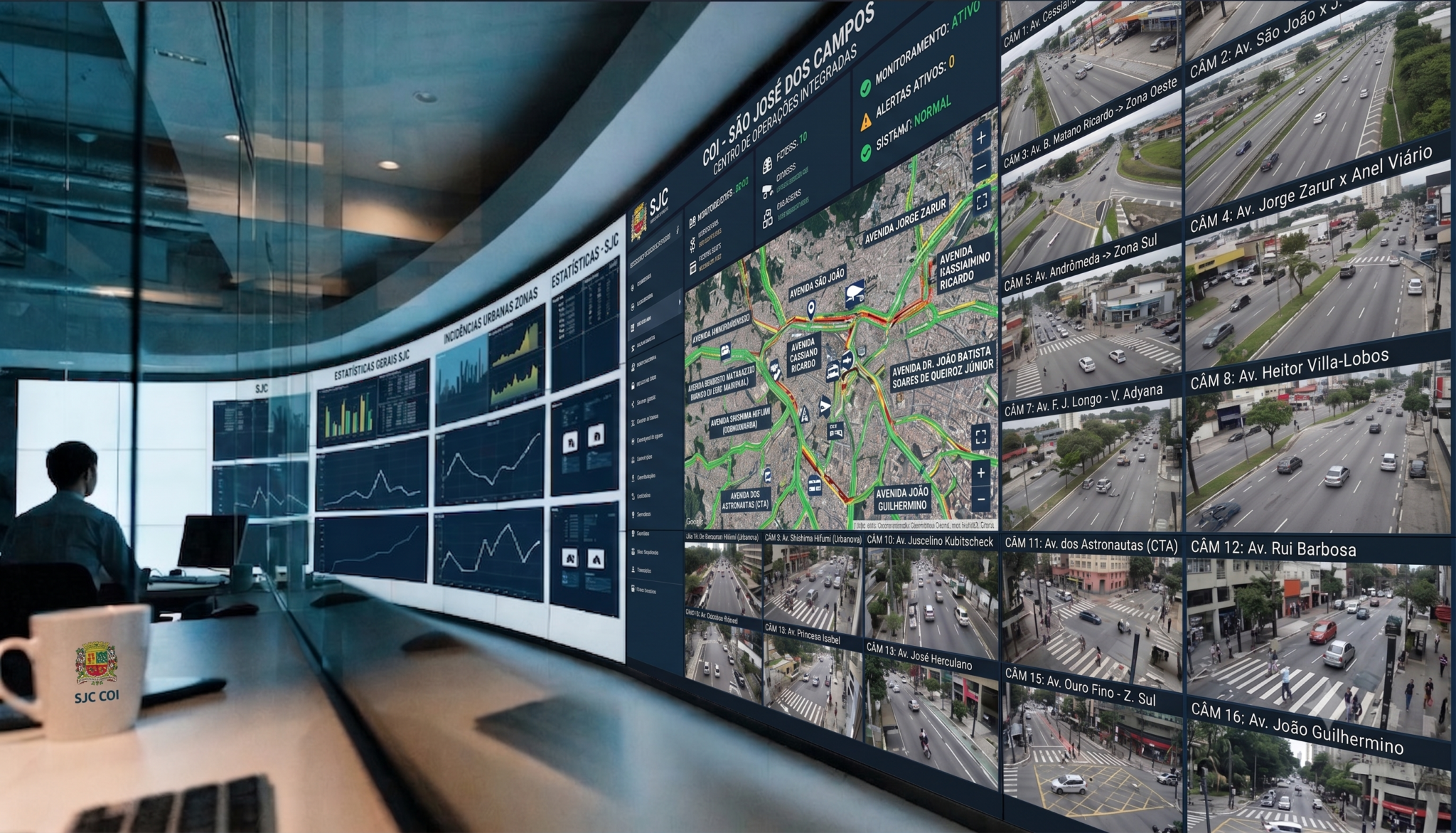
While São José dos Campos expands its investment and enacts its own AI law for public safety, Jacareí grows its monitoring system, and the State picks the region for São Paulo’s first electronic security belt, the Paraíba Valley shows signs it’s shifting from a set of cities to a network
Introduction
In under five months, three separate decisions, made by three different levels of government, changed how the Paraíba Valley handles public safety. One city expanded its monitoring center and enacted the region’s first municipal law authorizing the use of artificial intelligence in security. Another expanded its camera network the way you’d handle routine maintenance, not launch a new project. And the State Government chose this very region to test, for the first time in São Paulo, an electronic security belt that proposes integrating public and private cameras across dozens of municipalities, a regional pilot still in the rollout phase, as this article details further on.
None of these three moves, on its own, would justify an article. Together, they describe something bigger: AI-powered urban monitoring in the Paraíba Valley has stopped being a sum of scattered municipal initiatives and started behaving like a regional system under construction. That’s the reading this piece proposes, not an inventory of installed cameras.
Three headlines, one region
This isn’t an article about one city government. It’s an article about a region that, without any formal coordination among its players, started moving in the same direction at the same time.
On one side, São José dos Campos expanded its security center with a significant financial investment and passed a law creating a legal framework for AI use in municipal public safety. On another, Jacareí kept expanding its smart monitoring system as part of a continuous cycle, not a one-off project. And at the state level, the Paraíba Valley and North Coast became the first region in São Paulo chosen to receive the electronic belt from the Muralha Paulista program, an attempt to integrate public and private cameras at regional scale.
These are three different speeds, three different budgets, and three different levels of government. But the pattern that emerges when you look at all three together is clear: the Paraíba Valley has stopped treating electronic security as a one-off equipment purchase and started treating it as continuous infrastructure, municipal and state, running side by side.
From isolated initiatives to a regional standard for AI-powered urban monitoring
Each of the three cases, looked at separately, is a local news story. Looked at together, they form evidence of a regional movement that no single piece of coverage has captured until now.
São José dos Campos: financial scale and the Valley’s first legal milestone for AI in security
São José dos Campos is today the most robust case of public investment in AI-powered electronic security in the region. The city’s Security and Intelligence Center is in the process of expanding from 1,186 to 1,697 smart cameras, with an investment of R$64.8 million spread over 60 months. The expansion includes facial recognition and automated license-plate reading via OCR processed locally in patrol vehicles, which allows a plate to be identified even without a continuous connection to a central server, as well as taking rural-area coverage from 68% to 100% of the territory, backed by expanded fiber-optic infrastructure.
That multi-year investment gained a second chapter in February 2026, when the city government enacted Law No. 6,554/2026, which formally established the “São José Mais Inteligente” program and authorized the use of AI technologies for data integration and the recognition of people and vehicles. Few Brazilian municipalities have a specific law for this, which turns São José dos Campos into a legal reference, not just a technological one, for other cities in the Valley.
The results came quickly: in April 2026, the city closed the month with zero vehicle thefts, the lowest level since 2001, a result the city government attributes to the expansion of smart monitoring under the São José Unida program, even though crime rates also respond to other variables, such as stepped-up police patrols and seasonal variation. According to figures released by the city, this result adds to a program track record that, since 2021, has already logged 866 recovered vehicles, 410 wanted individuals captured, 1,867 suspects detained, and 3,971 incidents responded to.
Jacareí: when expansion becomes routine, not the exception
While São José dos Campos builds up financial scale and legal groundwork, Jacareí shows the other side of the same movement: keeping expansion going as an operational habit. In July 2026, the city’s Department of Public Safety and Citizen Defense installed a 7-meter-tall monitoring totem with 360-degree capture, LED lighting, an identification siren, and speakers for audio alerts, at Praça Conde Frontin. The totem is part of a larger rollout, another 70 monitoring devices are being installed around the city, with completion expected by the end of August 2026.
What stands out in Jacareí isn’t the equipment itself, but the pace. The city isn’t launching a new project, it’s keeping an existing system in continuous expansion, which signals that, for the region’s administrators, investing in smart monitoring has stopped being a one-time event and become a permanent cycle of expansion and upkeep.
Muralha Paulista: the Valley as the first pilot region for a statewide electronic belt
The third movement comes from outside the municipalities: the São Paulo State Government chose the Paraíba Valley and the North Coast as the first region in the state to receive the “Electronic Belt” of the Muralha Paulista program, which already integrates roughly 94,000 public and private cameras across more than 300 municipalities in the state, with facial recognition, automated license-plate reading, and cross-referencing against the National Arrest Warrant Database.
An important qualification is needed here. A state tender from May 2025 called for distributing 350 cameras across the 39 cities of the RMVale, with emphasis on municipalities such as Jacareí, Cruzeiro, Aparecida, Ubatuba, Caçapava, Guaratinguetá, and São Sebastião, with an installation deadline of three months after contracting. As of now, there’s no press confirmation in 2026 detailing completed physical installation, city by city, within the Valley, what does exist, publicly, is the state’s decision to treat the region as a pilot and the architecture of a program that already operates at state scale. Treating this belt as an already-finished project in each of the 39 cities would be getting ahead of a result that hasn’t been reported yet.
What changes for city governments and the market when this happens all at once
When three moves like these happen within the same window of time, the practical effect goes beyond any single case. First, it creates healthy competitive pressure among mid-sized cities in the region: no mayor wants to be the exception in a region that is publicly investing in AI-powered urban monitoring.
Second, integrating public and private data stops being an abstract concept and becomes a practical requirement. A statewide electronic belt only works if municipal cameras, voluntarily registered private cameras, and facial recognition systems can talk to each other, which requires protocols, governance, and technical capacity that go beyond buying equipment, including compliance with Brazil’s LGPD, since cross-referencing images for facial recognition involves processing biometric data, a category the law treats as sensitive.
Third, and perhaps most relevant in the medium term, São José dos Campos’s Law No. 6,554/2026 sets a real legal precedent. Other cities in the Valley that want to formalize the use of AI in public safety already have, within the region itself, a tested legislative model, which lowers the political and technical cost of replicating the initiative.
The bottleneck nobody’s talking about: having technology isn’t the same as operating intelligence
This is where the regional conversation needs to shift focus. Cameras, laws, and state-level integration together produce a growing volume of raw data. But raw data isn’t operational intelligence, it only becomes that when there’s a structure to process it continuously: a 24-hour operations center, a NOC ensuring the availability and health of camera and connectivity infrastructure, a SOC monitoring and responding to the security events and threats these systems generate, and a Service Desk capable of resolving failures before they turn into operational losses. In this design, an alert generated by facial recognition or plate reading doesn’t trigger a field response on its own: it goes through human validation at the operations center before any approach, which reduces the risk of false positives and is, in practice, what turns raw data into responsible decisions.
The clearest signal of where this kind of operation can head came from the state capital, not the Valley. In June 2026, the Military Police began integrating helicopter and drone footage into Muralha Paulista, with real-time facial recognition and plate reading, capture from up to 150 meters away, and infrared technology for nighttime operation. It’s currently a pilot project limited to the capital, with no confirmed expansion date to the interior, but it points to the direction of the country’s largest state security program: moving from fixed cameras toward integrated mobile and aerial platforms. If and when this layer reaches the Valley, the volume of data to be operated continuously will grow at the same pace, and the operational bottleneck that already exists today with fixed cameras will only become more evident.
Erione’s role in this regional context
That bottleneck, the gap between installing technology and operating it continuously, is also where Erione operates. Headquartered in São José dos Campos, at the heart of the region this article describes, the company works precisely at the layer of continuous operation for critical infrastructure: operation and intelligence centers (COI), a NOC for infrastructure availability and a SOC for security-event response, AI-powered video monitoring, connectivity, and a Service Desk for ongoing technical support.
Erione doesn’t manufacture cameras or write municipal laws. It works on the part of the process that rarely makes headlines but that decides whether an investment in electronic security produces a lasting result or turns into installed infrastructure that’s poorly used. That kind of capability, operating, sustaining, and integrating systems over time, is what separates a city with cameras from a region with real operational intelligence.
Conclusion: the Paraíba Valley can become a national benchmark — if it solves the next problem
The Paraíba Valley today has real evidence of coordinated investment in AI-powered urban monitoring, a robust municipal investment in São José dos Campos, continuous expansion in Jacareí, and the state’s bet on Muralha Paulista choosing the region as its pilot. That’s not a small thing, and it isn’t a coincidence of timing: it’s the picture of a region moving in the same direction, across different layers, at the same time.
But the leap from “cities with cameras” to “a region with operational intelligence,” the kind of advance Smart Cities projects try to capture elsewhere in the country, won’t depend on installing more equipment. It will depend on who takes responsibility for operating, integrating, and keeping all of it running every day, long after the launch fades from the news. That’s the question that still has no public answer in the Paraíba Valley, and it’s the one that will decide whether the region actually becomes a national benchmark or just another set of well-intentioned projects.
Want to see, in practice, what sets a monitoring center apart from an Operation and Intelligence Center (COI)? See how it works.
If your city, department, or operation is in the middle of this transition, from installing technology to actually operating it at scale and continuously, Erione can talk through how to build that operational capability. Talk to our team.
