
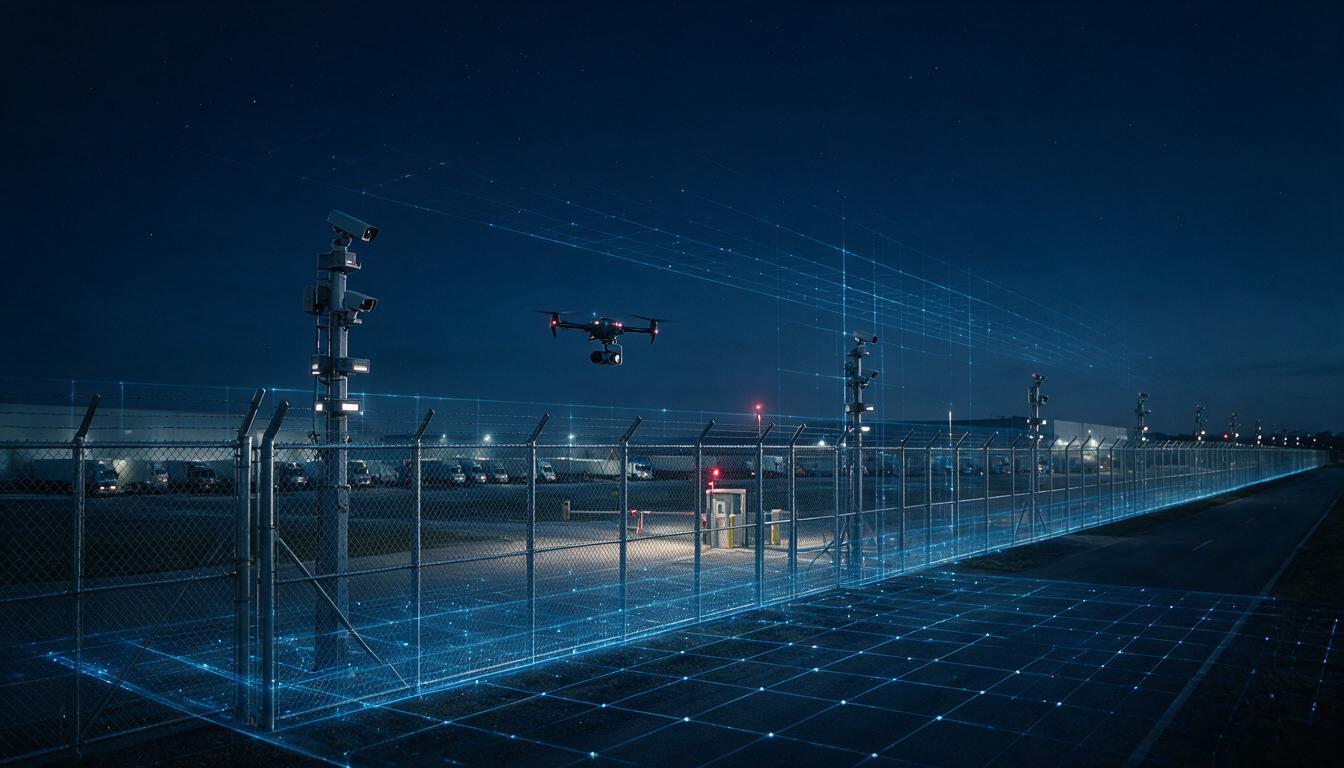
Radar, underground sensors and anti-drone response show that 3D perimeter security, covering what’s below and above the wall too, has stopped being a differentiator and become a necessity
If someone can map your entire perimeter from the air before taking a single step inside it, what exactly is your physical security protecting? The question is uncomfortable because it exposes a structural gap. Most physical perimeters were designed to watch the ground: fences, ground sensors, fixed cameras set at the height of a person walking. None of those layers was built to see something flying over the property.
Vendors in the perimeter security sector are already flagging a worrying market trend: the growing use of low-cost commercial drones for aerial reconnaissance of residential complexes and logistics hubs ahead of a break-in. Routines, camera blind spots, patrol schedules, all of it can be mapped from the air, without anyone setting foot on the property.
This thesis doesn’t depend on any one specific case. It depends on a structural fact that any security director can verify in their own project: the perimeter has stopped being a two-dimensional line, inside or outside the wall, and become a three-dimensional volume. Ground, underground and airspace only consistently close blind spots when these three layers are monitored as a single system.
The new reconnaissance before the crime
It’s a behavioral shift that makes technical sense on its own. Accessible commercial drones, the same kind used for photography, agriculture or deliveries, let someone fly over a residential complex or a logistics hub and capture in minutes what used to require days of risky in-person observation.
Camera blind spots, gaps between patrols, less-monitored gates, loading and unloading routines: all of it becomes visible from above, without the target ever noticing they’re being watched.
This is the reading worth holding onto, not the isolated episode cited by one vendor or another, but the reasoning behind it: the barrier to entry for hostile reconnaissance has dropped. Equipment that used to belong to sophisticated operations is now available to anyone willing to buy it.
The blind spot nobody designed to exist
Classic perimeter security architecture was born from a simple premise: the threat comes from outside and enters through the ground. Hence the fence, the presence sensor, the fixed camera aimed at ground level.
That logic works well against someone trying to climb a wall or cut a fence. But it was never designed to notice something flying over the property a hundred meters up, nor to detect movement underground, where there’s also vulnerability: pipelines, technical vaults, underground access points in industrial plants.
A few years ago, this was an irrelevant technical detail, because aerial reconnaissance technology was expensive and restricted. It got cheaper. It became a strategic risk.
From two-dimensional surveillance to 3D perimeter security
The response the perimeter security market has been consolidating around this gap is usually described as “three-dimensional perimeter security”: a ground layer (physical sensing and traditional video monitoring), an underground layer (seismic sensing, buried cables or rods that pick up vibration patterns and tell the difference between footsteps, digging or fence-cutting and ambient noise like traffic or wildlife).
The third layer is aerial: anti-drone detection systems that combine radar, radio frequency, acoustic sensors and optical or thermal cameras. It’s a necessary combination, because commercial drones fly low, slow and have a very small radar signature, which historically has made them hard to detect with a standalone conventional radar.
These technology categories exist and are commercially expanding. Naming them isn’t the same as recommending a specific manufacturer. The central point isn’t which radar or which sensor to buy, it’s understanding that these three layers, treated in isolation, keep producing the same old problem: blind spots that a well-prepared intruder will find.
What’s at stake for operators of critical assets
For an industrial security director, a corporate complex manager or a CISO running a critical operation, the risk isn’t abstract. Undetected aerial reconnaissance means someone has already mapped the perimeter’s weaknesses before any alarm ever sounds.
And the reconnaissance phase is, by definition, the cheapest moment to stop a threat: once the mapping is done, the decision to attack has already been made based on real information about the target.
There’s a second, quieter risk: a false sense of security. A perimeter with robust CCTV and well-installed ground sensing can feel fully protected, when in practice it’s only covering a fraction of the volume it needs to watch.
More ground-level cameras don’t solve a threat that comes from above or passes underneath. Continuing to operate on that premise means keeping a structural vulnerability disguised as a security investment.
The strategic path: from isolated sensors to operational intelligence
The right answer isn’t adding one more piece of equipment to the shopping list. It’s recognizing that ground, underground and airspace only work as real defense when they converge into a single correlation logic. A vibration signal underground, an aerial detection and a ground-level camera alert need to be interpreted together, by an operation capable of deciding in real time whether that’s a coordinated threat or three unrelated isolated events.
Disconnected sensors still depend on someone, or some system, to connect the dots, no matter how sophisticated each one is individually. Without that layer of continuous correlation and decision-making, the three-dimensional perimeter remains, in practice, three separate perimeters, watched by systems that don’t talk to each other.
A hypothetical scenario helps make this concrete. Buried seismic sensing near the fence picks up a vibration pattern consistent with footsteps or digging; minutes earlier, the aerial detection system flagged a drone flying over exactly that stretch of the perimeter; and a ground camera, in that same time window, catches a vehicle parked nearby with no apparent reason.
Handled in isolation, each of these three signals would be classified as a low-priority event: vibration could be wildlife, a flyover could be recreational, a parked vehicle could just be a brief stop. Correlated by a SOC that sees all three layers at once, they stop being noise and become a single coordinated-reconnaissance alert, with elevated priority and an immediate response.
How this architecture applies also changes depending on the type of asset. In a corporate complex, the perimeter tends to be more compact and urban, with higher camera density and fewer underground access points. The aerial layer tends to close the most gaps, since ground and surroundings are already well covered.
In a logistics hub or industrial plant, the challenge is different. The perimeter is extensive, often with pipelines, technical vaults and other underground access points that need dedicated seismic sensing, plus multiple gates and loading areas that widen the number of possible blind spots. In both cases, the three-layer architecture is the same. What changes is where each layer needs more sensor density and monitoring.
Where Erione fits into this picture
This is exactly where Erione’s work connects to the problem: turning scattered sensor layers into a single operational intelligence. Erione doesn’t manufacture radar, seismic sensors or aerial detection systems. It acts as the integration and continuous-operation layer that’s missing from most perimeter security projects.
The NOC makes sure sensors, cameras and connectivity are working and transmitting data reliably. The SOC correlates the security events generated by these layers, ground, underground and air, and decides what’s a real threat. The Integrated Operations Center ties that security reading to the site’s physical operation, monitoring everything 24 hours a day under a single alert-correlation logic.
In practice, an underground event, an aerial detection and a camera alert stop being three notifications in three different systems. They start being read as a single situation, assessed and answered by an operation that understands the perimeter as a whole, not just the slice each sensor sees on its own.
Conclusion: the perimeter of the future isn’t a line, it’s a volume
The perimeter security conversation has shifted in recent years, and much of the market hasn’t caught up yet. The perimeter has stopped being a line drawn on the ground: the wall, the fence, the guard booth. It’s become a volume, what the market now calls 3D perimeter security: ground, underground and airspace monitored as a single risk surface.
Whoever still thinks in two dimensions is, in practice, only protecting a slice of their own perimeter. Whoever is planning an incident has already learned to exploit exactly the layers that got left out. The question left isn’t which sensor to buy next. It’s which part of the current perimeter is still invisible, and how long it’s been treated as if it didn’t exist.
Before deciding which technology to add to your perimeter, it’s worth mapping with an Erione specialist which layers, ground, underground or airspace, are still operating in isolation or simply don’t exist in your operation today.
Want to understand how Erione’s IOC, NOC and SOC correlate ground, underground and air alerts into a single operational decision? Talk to a specialist.
