
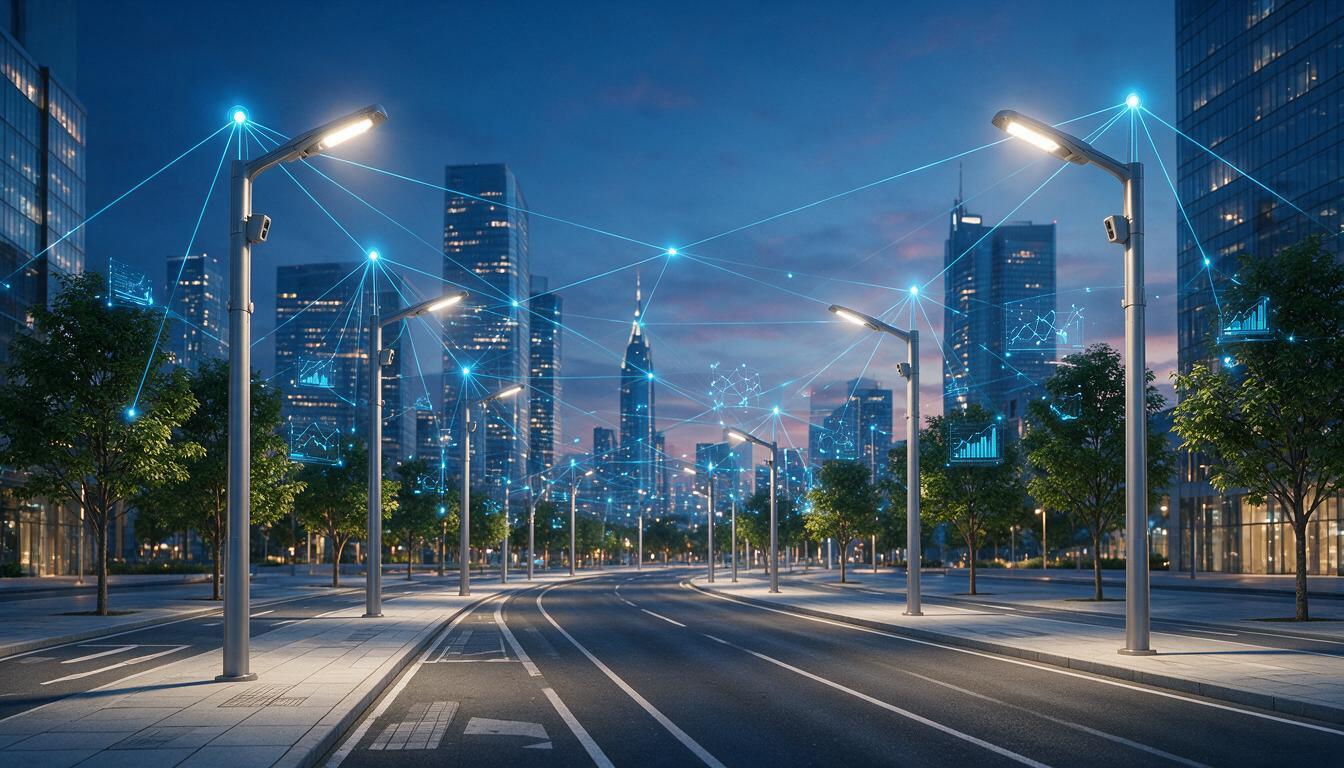
With more than 180 Brazilian municipalities already under remote management and the Tax Reform unlocking new funding sources via COSIP, the challenge is no longer technological, it’s operational: who will monitor, analyze, and act on the data each pole now generates?
Introduction
When a city decides to modernize its street lighting, the first question is usually about bulbs: how many fixtures to replace, which LED technology to use, how long installation will take. It’s a legitimate question, but an incomplete one. And it’s exactly that incompleteness that separates projects generating a one-off saving from projects that become strategic infrastructure. A survey published by Exame (Bússola) on 07/01/2026 shows that smart lighting modernization with remote management already operates in more than 180 Brazilian municipalities, benefiting around 60 million people, with crime incidents down by as much as 30% and energy costs cut between 50% and 70%.
One caveat is worth making upfront: the reduction of up to 30% in crime incidents is a result observed in the municipalities assessed by the report, conditional on structured monitoring and response, not an automatic guarantee of any remote-management project, a point this article details further on. That caveat aside, the numbers remain striking. But the most relevant fact in the report isn’t the energy savings: it’s that the same network lighting the street also hosts sensors, connectivity and monitoring capacity. The question this article sets out to answer is different: does smart street lighting deliver results because of the bulb that got replaced, or because of the capacity to continuously operate the data network it creates? The thesis here is direct: the fiscal and safety gains don’t come from the LED or from remote management on their own. They come from continuous operation over the sensor network this infrastructure now forms.
The numbers behind the shift in scale
- More than 180 Brazilian municipalities already operate street lighting under remote management
- About 60 million people benefiting from these projects
- Up to 30% reduction in crime incidents in covered areas (conditional on structured monitoring and response)
- 50% to 70% cut in energy costs through remote management and smart dimming
Source: survey published by Exame (Bússola), 07/01/2026.
The smart streetlight pole has become a strategic asset, not a maintenance line item
For decades, street lighting was treated, in municipalities’ budgetary and operational practice, as a corrective-maintenance item: a bulb burns out, a resident complains, a work order is issued, it gets replaced. The investment existed, but it was scattered and reactive. The numbers from the Exame survey indicate this scenario has changed scale: these are no longer isolated pilot projects, but a national network that already spans more than 180 municipalities and 60 million beneficiaries, with measurable results both on the fiscal side (a 50% to 70% cut in energy costs) and on the public-safety side (up to a 30% reduction in crime incidents in covered areas). When an investment in urban maintenance reaches this scale and produces this kind of replicable result, it stops being a facilities-maintenance line and becomes a strategic municipal asset, something that enters the budget conversation, the public-safety conversation, and the digital-infrastructure conversation all at once.
From burned-out bulbs to real-time data
What underpins this shift is remote management. Each fixture gets a connected controller, linked via RF (radio frequency), PLC (power-line communication, which uses the electrical wiring itself to transmit data) or cellular, to a central management platform. That connection does two things at once: it shows, in real time, which fixtures are on, off, showing a technical fault, or displaying a consumption anomaly (a deviation from the load curve expected for that time of day); and it lets operators remotely adjust the dimming level of each point, or group of points, according to the time of day or the flow of people and vehicles on the street.
It’s this second mechanism, fine-tuning light intensity, not just swapping the bulb for an LED, that explains much of the energy-cost cut reported in the Exame survey. A practical example makes this concrete: on a low-traffic street, the system can schedule a dimming period between midnight and 5am, the lowest-movement window, with an automatic return to full intensity if a sensor detects motion, preserving street safety without keeping energy consumption at its peak all night. The difference is both operational and cultural: under traditional management, a problem is only known once it has already bothered someone; under remotely managed operations, the problem is detected, and often fixed, before it becomes a complaint. That shift, from reactive to predictive, is the first sign that the lighting network has started behaving like a data network, not just an electrical one.
One distinction is worth making here, so two related concepts aren’t treated as synonyms. Remote management is the system that manages the fleet of fixtures: the controller, the communication protocol, the central platform that monitors and adjusts each point. The pole’s physical infrastructure (available power, installed connectivity, physical space), on the other hand, is what additionally enables hosting broader urban sensors: video-monitoring cameras, environmental sensors, vehicle-flow counters, public Wi-Fi points. These are related layers, but not equivalent ones: a municipality can have robust remote management without hosting a single additional sensor, and turning the pole into an urban IoT hub is a decision, and an investment, that goes beyond remote management itself.
The 2026 trigger: why investment is accelerating now
This movement isn’t happening by chance right now. The Tax Reform and the new COSIP-based funding sources starting in 2026 change municipalities’ fiscal math, opening a concrete, not just theoretical, window to fund street-lighting modernization at scale. That regulatory backdrop explains why the topic has moved out of experimental innovation and into the current agenda of public works, planning, and finance departments: there is now revenue predictability tied specifically to this type of investment. It’s a context in which choosing not to invest now carries a clearer opportunity cost than choosing to invest.
Cases that prove the leap
Evidence that this model has already moved past the pilot stage shows up in concrete cases cited by the Exame report itself. The Smart Luz program in Rio de Janeiro, and the municipality of São José dos Campos (which earned ISO 37125 Platinum certification, the first city in the world to reach that level, a recognition reserved for cities with consolidated smart urban management) show that well-structured remote management generates measurable results that are recognized externally, not just short-term internal savings.
Canaã dos Carajás illustrates an even more telling path, right in line with the distinction made above: there, the lighting infrastructure was integrated into a fiber-optic network that also serves health and education, the clearest proof that the pole has stopped being an isolated piece of remote-management equipment and become part of a multi-use urban infrastructure mesh, the same kind that, in other national projects, already hosts public Wi-Fi points, air-quality sensors, and vehicle-flow counters.
What’s at stake for municipalities and utilities
The risk, at this moment of acceleration, is that much of the market still treats this investment as simply “swapping bulbs for LEDs with remote management”: an energy-efficiency project with a delivery date and a savings report. That reading isn’t wrong, but it’s incomplete, and the incompleteness has a cost. Municipalities and utilities that treat the project purely as fixture replacement risk leaving on the table the data-network potential the infrastructure has already created: environmental sensors, video-monitoring cameras, Wi-Fi/LoRaWAN connectivity hubs that sit idle without structured use. At the same time, pressure for fiscal accountability is growing: public managers need to show, with numbers and not just promises, the return on every dollar invested in urban modernization. Whoever can demonstrate not just energy savings but also measurable safety gains and operational efficiency will have a stronger case, both for renewing contracts and for justifying new investment.
From a network of poles to a network of decisions
This is the core of the thesis: remote management generates data, but data without continuous operation never becomes a decision. A sensor network that flags a fault, a consumption spike, or an out-of-pattern event only produces real value if, on the other side, someone, or some structured process, is monitoring it, correlating that information, and defining a response. Without that link, a remotely managed network is, at best, a good-looking dashboard that rarely gets acted on. With that link, the same lighting network starts functioning as safety and urban-intelligence infrastructure, because every captured event turns into a concrete action: a sensor detects an anomaly, the management platform generates an alert, a triage team assesses priority and dispatches a work order or notifies public safety. The difference between these two scenarios isn’t the technology installed, it’s the capacity to operate that technology every day, in real time.
Where operational capacity makes the difference
It’s precisely at this layer, the one that rarely shows up in smart-lighting project announcements but that underpins every promised result, that specialized operational-intelligence providers become relevant. Integrating IoT, video monitoring, and connectivity under continuous operation, structured around Integrated Operations Centers (IOC) or Network Operations Centers (NOC), is what separates a network of connected poles from a network that is actually operated.
An IOC typically brings multiple stakeholders together around the same urban event, such as public safety, traffic, and civil defense, while an NOC focuses on the operation and availability of the network and connectivity infrastructure that supports those sensors. It’s this kind of capability, 24-hour monitoring, event correlation across different sensors, and clear response protocols, that companies like Erione build together with municipalities and utilities, not as suppliers of fixtures or remote-management platforms, but as the party responsible for turning the constant flow of data these networks generate into consistent operational decisions, day after day.
Conclusion: the future of urban maintenance is operation, not equipment
The investment cycle in smart street lighting that opens up in 2026, driven by the Tax Reform and new COSIP funding sources, is set to expand the number of municipalities running remotely managed networks even further, and to connect with a broader agenda of PPPs aimed at smart cities, one that already mobilizes governments, utilities, and technology integrators across the country. But the criterion that will separate successful projects from projects that can’t sustain their own results won’t be the LED brand installed, or the remote-management platform chosen. It will be the capacity to continuously and systematically operate the data this network generates. Municipalities, departments, and utilities that understand this now, and design operations as part of the project from the outset rather than as something to figure out after installation, will be ahead of the curve in the next generation of urban-maintenance contracts.
If your municipality or utility has a smart-lighting project underway or in the planning stage, one objective question is worth asking before moving to the next stage: was this project designed from the start with continuous operation in mind (monitoring, event correlation, and response), or is that layer being left for later? Erione talks with public managers and utilities about exactly this: how to build operational capacity into the project from its conception, so the lighting network delivers the full safety and efficiency potential the sector’s numbers have already proven possible.
Not ready for a sales conversation yet? Learn how an Integrated Operations Center (IOC) works in practice, and see why it’s the piece that turns sensor data into real-world response.
